
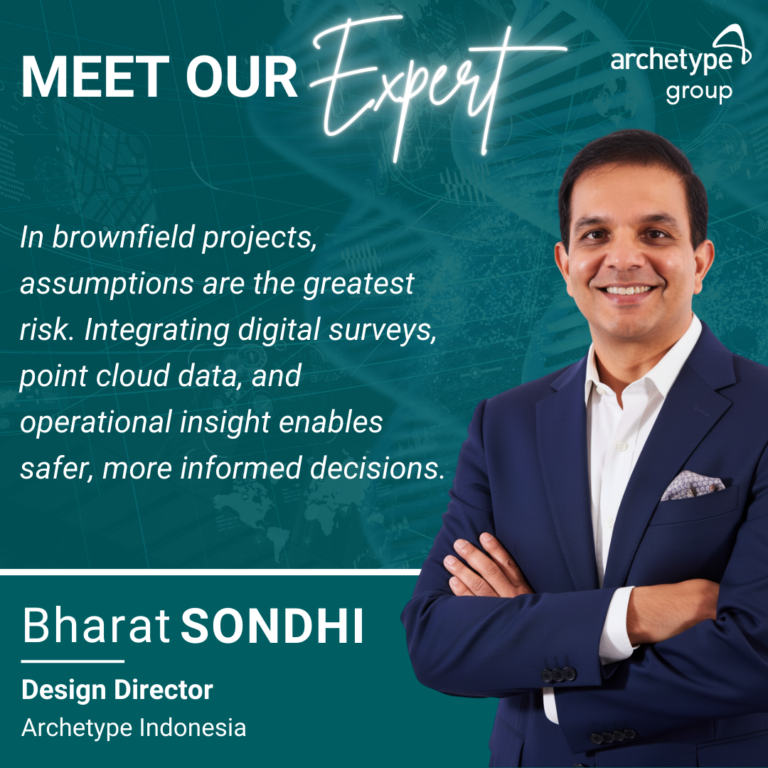
In this edition of our Meet the Expert series, we highlight Bharat Sondhi, a Design and Engineering expert with over 25 years of experience across Data Centers, Food and Beverage, Chemical, pharmaceutical sectors, Cement plants and power plants.
Over the course of his career, Bharat has led complex projects by optimizing design workflows, strengthening collaboration across disciplines, and delivering practical, high-performance solutions. He excels in aligning design strategies with business and operational objectives, consistently driving efficient outcomes while managing technical complexity.
He brings specialized expertise in CSA (Civil, Structural, and Architectural) and MEP (Mechanical, Electrical, and Plumbing) integration, offering robust technical leadership to ensure projects meet all requirements efficiently and accurately. His focus on strategic planning, innovative design, and sustainability elevates both operational efficiency and long-term scalability. Bharat’s designs are resilient, economical, and geared toward future growth.
His strategic approach and technical depth make him a trusted leader in delivering integrated design solutions across diverse and evolving industrial environments.
Q1. What makes brownfield projects particularly challenging compared to greenfield developments?
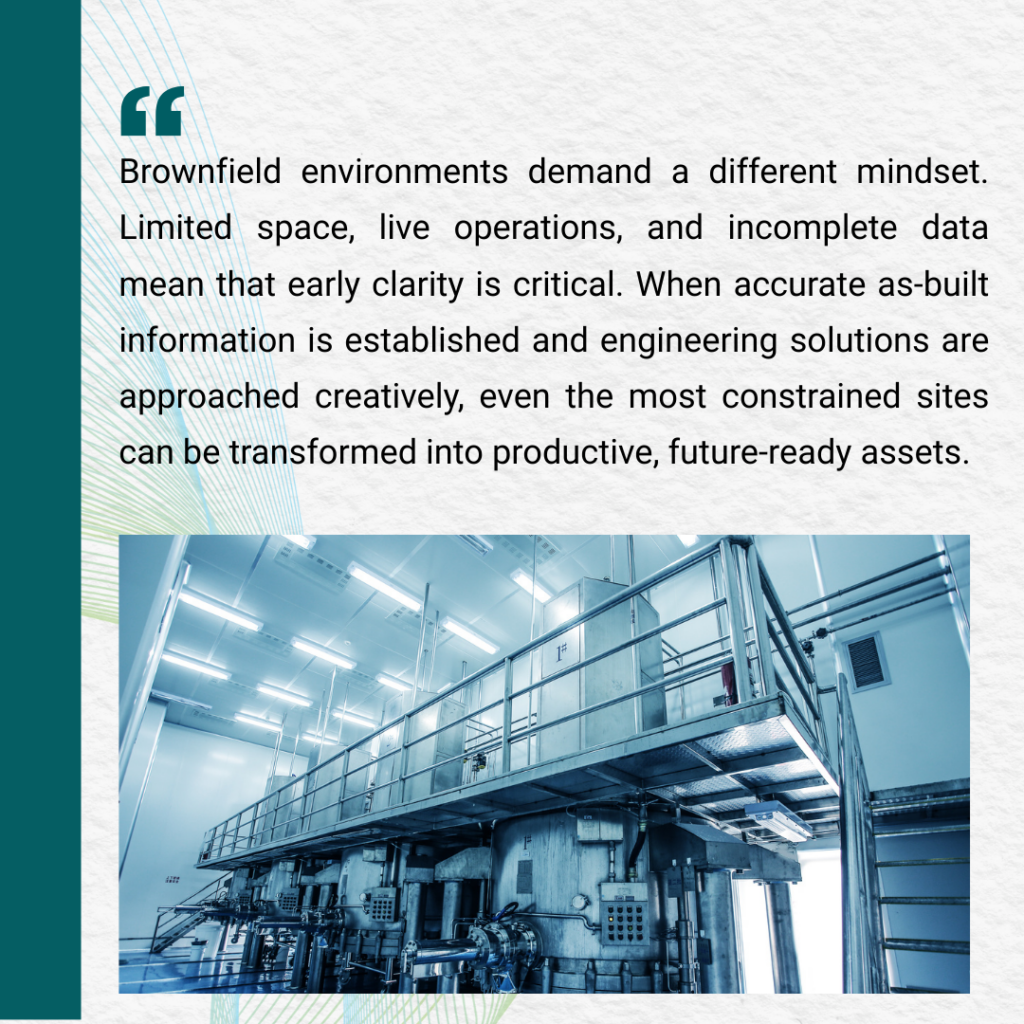
Brownfield projects are complex because they must be delivered within live, operational environments. These projects often face restricted space, ongoing production activities, continuous material movement, and limited access for construction teams. In many cases, existing as-built documentation is outdated or incomplete, both above and below ground, which increases technical risk. Unlike greenfield developments, there is little flexibility to redesign layouts freely, making early understanding of constraints critical to project success.
Q2. How do you establish design clarity when existing information is limited or unreliable?
The priority is to create a reliable foundation for information. At Archetype, this begins with a combination of digital surveys, laser scanning, and point-cloud mapping, supported by manual site verification. Equally important are detailed discussions with clients and operational teams, where practical, on-the-ground knowledge is translated into precise technical requirements. This integrated approach allows us to rebuild accurate as-built documentation, reduce uncertainty, and enable confident, informed design decisions from the outset.
Q3. How do engineering strategies adapt to maximize space in highly constrained environments?
Once accurate data is established, the focus shifts to optimization. In space-constrained environments, every square meter must serve a clear purpose. Compact and modular engineering solutions play a critical role, allowing systems to be efficiently integrated within existing structures without disrupting operations. Through careful coordination and creative design thinking, layouts are refined to improve functionality, maintain safety, and support future flexibility, even within tight physical boundaries.
Q4. Why is early collaboration between Structural and MEP teams critical to successful engineering outcomes?
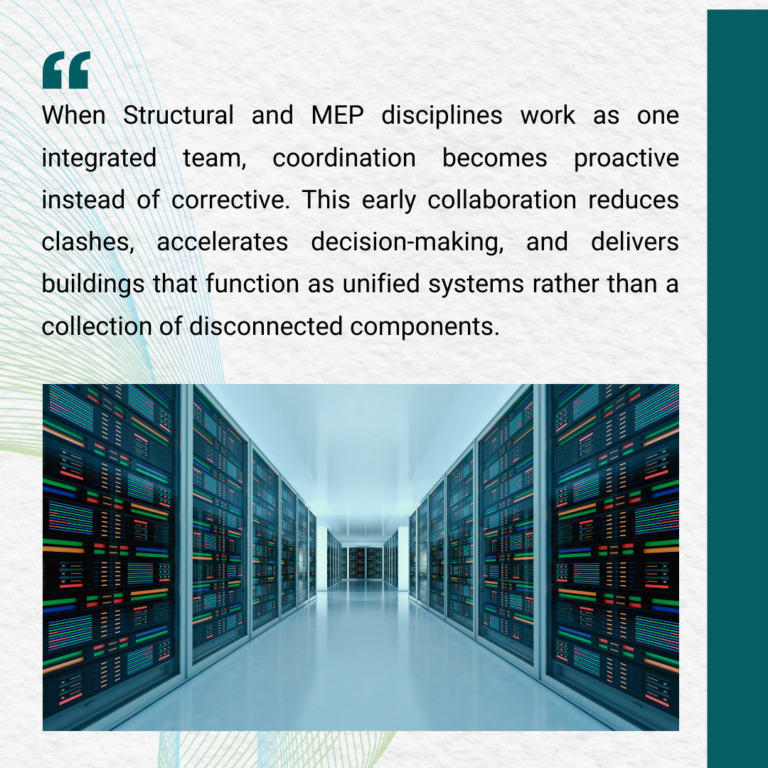
Engineering thrives on coordination, early dialogue, and practical problem-solving. When Structural and MEP teams work together from the very beginning, the design process becomes integrated rather than reactive. This early alignment enables optimized system layouts, cleaner routing, and safer, more efficient solutions. It also accelerates coordination, reduces downstream conflicts, and ensures that the building functions as a cohesive whole rather than a collection of independent systems.
Q5. How does genuine Structural–MEP integration improve innovation, coordination, and overall project value?
Transparent communication between disciplines speeds up decision-making and eliminates clashes at an early stage, when changes are least disruptive. By breaking down traditional silos, teams are encouraged to challenge assumptions, develop stronger ideas, and solve problems collaboratively. This results in one unified, well-coordinated design instead of fragmented, discipline-specific outputs. Genuine integration becomes a powerful differentiator, delivering higher-quality outcomes, smoother execution, and long-term operational value for clients.