
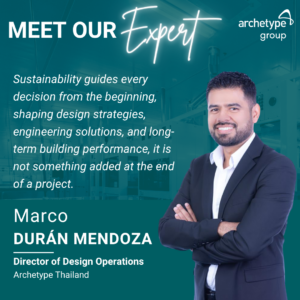
Continuing our “Shaping a Sustainable Tomorrow” campaign, we meet Marco, Director of Design Operations at Archetype Thailand, in this edition of our Meet The Expert series. Recognized as one of Archetype Group’s leading sustainable design experts for industrial projects, Marco brings an international perspective shaped by multidisciplinary experience.
Over more than 15 years of international practice, Marco Antonio Duran Mendoza has built his experience across diverse cultural and professional environments, including Senegal, India, Haiti, Myanmar, and Bolivia. Across these experiences, he has developed a strong foundation in sustainable design, shaping projects through a multidisciplinary and collaborative approach.
In this edition of Meet The Expert, Marco shares his insights on embedding sustainability into industrial projects and how early coordination supports sustainable outcomes throughout the project lifecycle.
———————————————-
Q1. How do you embed sustainability into the core of a project?
Embedding sustainability into a project starts from the very first conversations with the client. It is not something that gets added at the end, but a design principle that guides each decision from the concept stage.
At the beginning of the project, clear performance targets are defined, including energy use, daylighting, water efficiency, material requirements, and indoor environmental quality. These targets allow the entire team, from architecture to MEP, structure, and process utilities, to work toward the same sustainability outcomes.
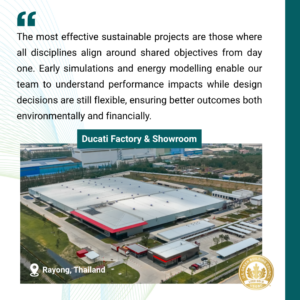
In industrial projects such as the Ducati facilities, early coordination is essential. Simulations and energy models are developed at concept stage to understand how the building shape, orientation, envelope, and HVAC strategy will perform. This allows informed decisions to be made while changes are still easy and cost-effective.
Q2. How do you align client expectations with sustainability objectives?
The client is actively involved throughout the process. Each sustainability option is explained clearly, whether related to envelope performance, high-efficiency systems, renewable energy readiness, or low-carbon materials.
When clients understand the long-term value of these decisions, they become part of the sustainability strategy. Aligning client expectations with sustainability objectives therefore means bringing design intentions, performance targets, and client priorities together from the beginning, and maintaining that alignment throughout the development of the project.
Q3. How does an EPCM approach help maintain sustainability targets from concept to construction?
One of the advantages of delivering a project through a full EPCM model is the control it provides across the entire project chain, from early design decisions to construction and commissioning. This allows sustainability targets defined at the beginning of the project to be maintained throughout delivery.
In the Ducati project, all disciplines were provided within one coordinated approach, including architecture, structural and MEP engineering, interior design, and LEED consultancy. Sustainability was not treated as a separate track but embedded into every design package, including the architectural envelope, HVAC strategy, lighting design, material specifications, and interior finishes.
Q4. How are sustainability objectives preserved during engineering and construction phases?
During the engineering phases, the LEED team works closely with the design teams, reviewing each package to ensure targeted credits remain achievable.
Once the project moves into procurement and construction, the Construction Management team verifies material submittals, checks installation quality, and ensures contractors understand why certain details are essential to achieving certification. This continuous involvement from concept through handover ensures sustainability remains a consistent thread linking design intent, engineering solutions, and construction execution.
Q5. What is the financial impact of a sustainable building?
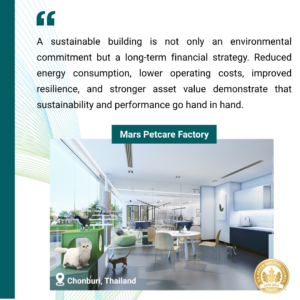
A sustainable building is both an environmental and a financial decision. High-performance buildings reduce energy consumption, water use, and maintenance costs. For industrial clients operating energy-intensive facilities, this results in significant annual savings and shorter payback periods for efficient systems.
Sustainable buildings also protect asset value through improved resilience, lower lifecycle costs, and alignment with evolving regulations. In some cases, sustainability measures can reduce insurance premiums, particularly where FM requirements and risk management are important.
In addition, companies operating certified or high-performance buildings often strengthen their corporate image and attract talent more easily. The financial impact can therefore be measured through lower operating costs, stronger long-term asset value, reduced risks, and improved brand positioning.